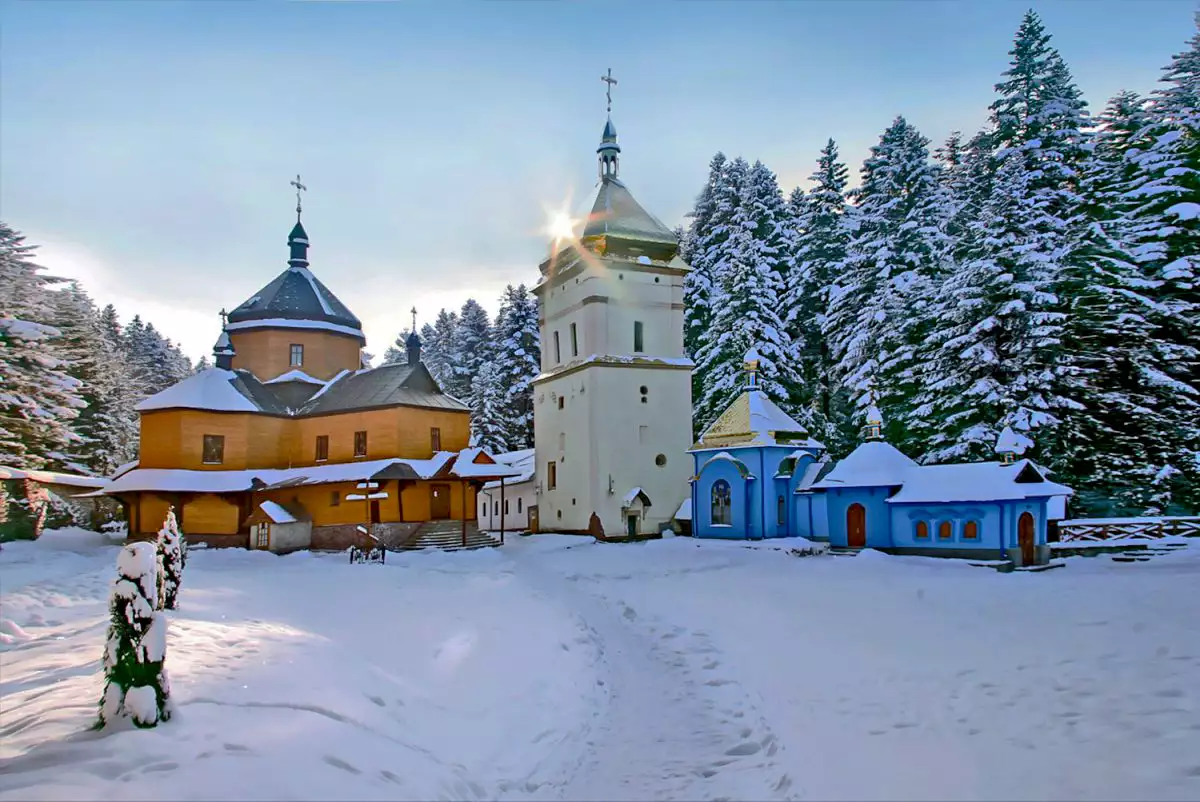
Manyava Hermitage (Exaltation of the Cross Monastery)
Ukrainian Athos among the Gorgany Mountains with healing spring
About This Site
Manyava Hermitage is an ascetic men's monastery of the Eastern rite, founded in 1606 in an isolated wooded area of the Gorgany Mountains. Known as 'Ukrainian Athos', it is an important center of spirituality and culture with a healing spring on the Blessed Stone.
The Manyava Exaltation of the Cross Men's Monastery, known as Manyava Hermitage or Ukrainian Athos, is an Orthodox monastery near the village of Manyava in Ivano-Frankivsk Oblast. It was founded by St. Job Kniahynytsky when he settled in an isolated wooded area in the Gorgany Mountains on the banks of a tributary of the Bystrytsia Solotvynska River. Although Job planned to live in solitude, he soon began to attract other monks and believers, who built the first cells of the monastery in 1611 and then a wooden church in 1612. Later, additional cells were constructed, and with the patronage of O. Mohyla, the daughter of a Moldavian magnate, the main church of the Exaltation of the Cross was erected. In 1620, Constantinople Patriarch Timothy II granted the monastery stauropegion status, which enabled it to remain Orthodox despite the subsequent conversion of the entire region to the Uniate church. Manyava Hermitage soon came to house nearly 240 residents. It became a model of monastic life throughout Ukraine and maintained close relations with monasteries in Uhornyky, Kolomyia, Tovmach, and Suceava (Moldavia). The hermitage was also an important cultural center. Its library contained many rare manuscripts and books, and it was the site of one of the first professional schools of church music in Western Ukraine. Although the monastery was fortified by a defensive wall and three towers (a gate tower, a bell tower, and a defensive tower), the Turks destroyed it in 1676. It was rebuilt in 1681. In September 1785, the hermitage was closed by order of the Austrian government, and its monks dispersed to monasteries in Kyiv and Bukovyna. The monastery collapsed in ruins, and only the outer walls and the foundations of the main church and bell tower remained. Throughout its 150-year existence, the hermitage was renowned for the asceticism of its monks. Many laymen asked to be buried there, including Hetman Ivan Vyhovsky. Most of the monastery's important artifacts have not survived, but the iconostasis by Yov Kondzelevych, painted in 1698–1705, was taken to Bohorodchany after the monastery was closed, and then deposited in 1923 in the National Museum in Lviv. In 1785, the wooden church of the hermitage was transferred to Nadvirna, where it stood until it was destroyed by fire in 1914. In 1972–80, restorations were conducted on the site of the hermitage, and all three main towers, the defensive walls, and the wooden and stone cells were rebuilt, and the frescoes restored. In 1981, it was made into a branch of the Ivano-Frankivsk Regional Studies Museum. In 1998, the Manyava Exaltation of the Cross Men's Monastery was revived and remains active today. The Manyava Hermitage has inspired many literary and artistic works (e.g., by Antin Mohylnytsky, Ivan Franko, Yakiv Holovatsky, Osyp Makovei, Nataliia Kobrynska and Ivan Trush), and Ivan Vahylevych wrote a historical study of it in 1848.
Historical Significance
According to tradition, the history of the site dates to 1240, when monks Ionikiy and Pachomius from the Kyiv-Pechersk Lavra destroyed by the Mongols, taking holy water with them, went to look for a source of equal healing power and found it near the current monastery on the Blessed Stone, next to which they settled. Official founding of the monastery occurred in 1606 by St. Job Kniahynytsky and Ivan Vyshensky. First cells built in 1611, church in 1612. Received stauropegion status in 1620. At its peak (17th c.), the hermitage had about 200 monks and dozens of subordinate monasteries in Galicia, Bukovyna and Moldova. Destroyed by Turks in 1676, rebuilt in 1681. Closed by Austrian government in 1785. Restoration conducted in 1972–1980, museum opened in 1981. Monastery revived as active establishment in 1998.
Manyava Hermitage is an outstanding monument of Ukrainian Orthodoxy and culture. It was one of the most important spiritual and cultural centers of Western Ukraine, a model of monastic life and a center of education. The iconostasis by Yov Kondzelevych is a masterpiece of Ukrainian sacred art. The Blessed Stone with healing spring remains a pilgrimage site.
Highlights
- ✓Blessed Stone with healing spring (830 m from monastery)
- ✓Restored defensive walls and three towers
- ✓17th-century wooden and stone cells (reconstruction)
- ✓Historic printing house (museum exposition)
- ✓18th-century frescoes
- ✓Picturesque mountain location among Gorgany
- ✓Active men's monastery
Photo Gallery


Plan Your Visit
Opening Hours
Open year-round
Year-round
Daily: 09:00 - 18:00
Admission
Free admission. Donations welcome
Contact
Getting There
🚗 By Car
From Ivano-Frankivsk on H09 highway through Bohorodchany to Manyava. From parking near village walk to monastery (about 1 km)
🚌 Public Transport
From Ivano-Frankivsk bus to Bohorodchany or Nadvirna, then minibus or taxi to Manyava (about 40 km from Ivano-Frankivsk)
🅿️ Parking
Free parking near Manyava village
Facilities
Similar Heritage Sites
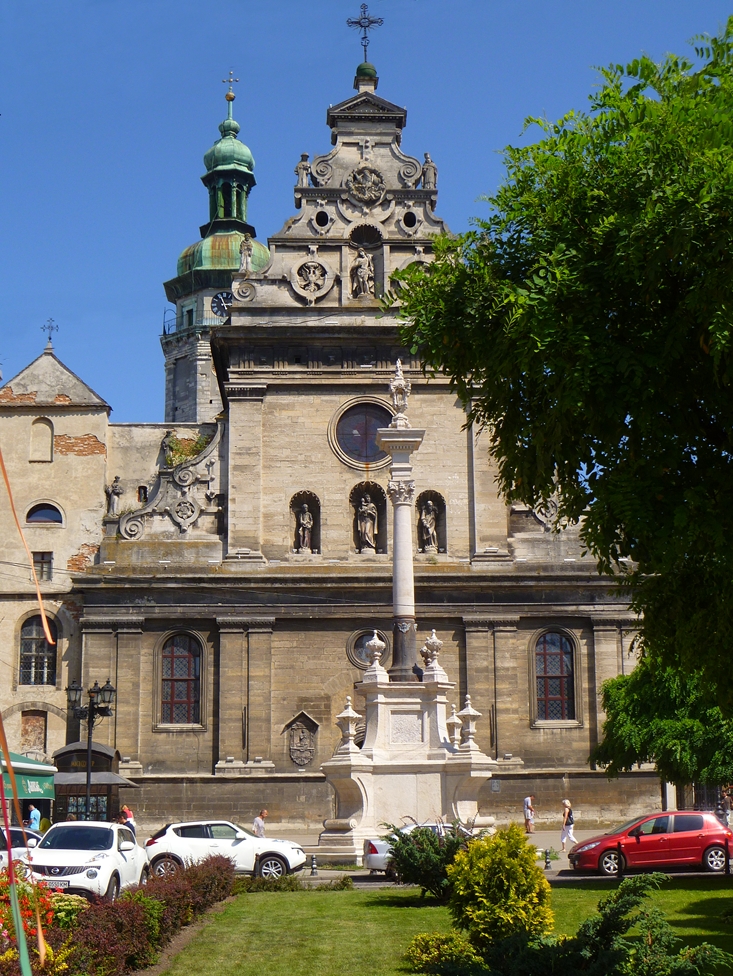
Bernardine Church and Monastery
17th century fortified monastery with unique fortifications
Learn More →
Kyiv-Pechersk Lavra
The spiritual heart of Ukraine and cradle of Orthodox faith
Learn More →
Holy Dormition Pochaiv Lavra
Ukraine's second most important Orthodox shrine atop Kremenets Mountains
Learn More →